Water Heater Leaking From the Bottom? Causes & What to Do
Water pooling under your heater doesn't always mean a failed tank. Here's how to read the signs — and what to do next.
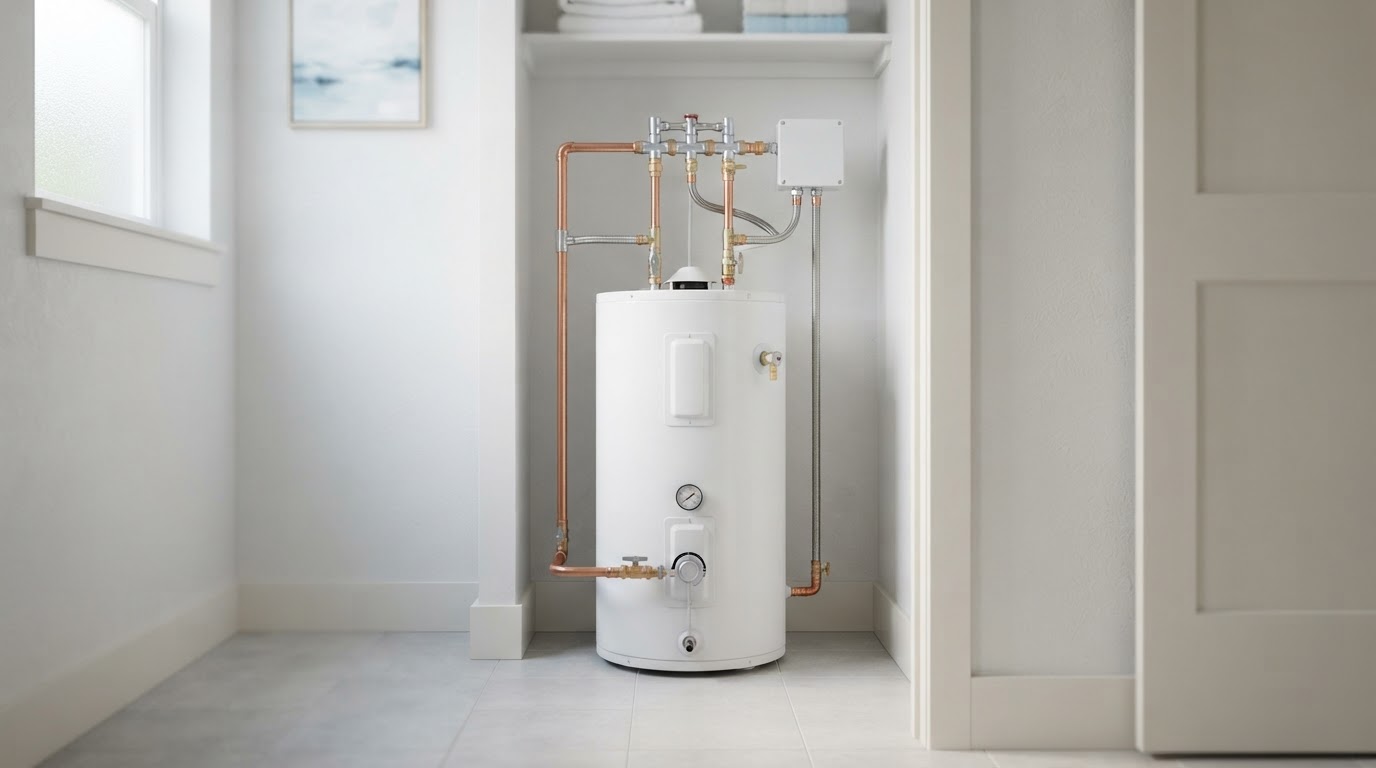
Rob walks through this exact problem in a short video.
Prefer to watch? This quick walkthrough covers the same checks you'll read below.
Is your water heater leaking from the bottom? It's a fair question to panic over — a puddle under the tank feels like an emergency. But water collecting at the base doesn't automatically mean the tank has failed.
More often than not, the water you see is coming from a connection, a valve, or even just condensation — things you can identify and, in some cases, address before anything gets worse. This guide walks through the most common reasons a water heater leaks from the bottom, what to check in what order, and when it's time to stop troubleshooting and call a pro.
Why water shows up at the bottom
Because of gravity, almost every leak on a water heater — no matter where it starts — eventually ends up on the floor underneath. A drip from the top can run down the side of the tank. A slow weep from a fitting hides behind the jacket. So the puddle tells you water is escaping, but not exactly where. Before assuming the worst, trace it to the source.
- Dry the area completely with a towel, then watch where the first drop reappears.
- Check the top of the tank and the pipes above for moisture running downward.
- Inspect the side and base fittings — the drain valve and T&P valve are the usual suspects.
- Look under the tank only after ruling out everything above it.
Drain valve leaks
The drain valve at the bottom of the tank is one of the most common leak sources. Sediment can keep it from closing fully, or the washer inside can harden and leak a slow, steady drip. It's a small part, but it's under full tank pressure — even a tiny seep adds up.
Leaks from plumbing above
Water runs downhill. A slow leak at the cold water inlet, the hot outlet, or the flex connectors up top can travel down the side of the tank and pool at the base. Tighten any hand-loose connections gently, and dry the top of the tank to confirm the source. Don't force a fitting — over-tightening cracks the nipple.
T&P relief valve discharge
The temperature & pressure relief valve is a safety device. If it releases water, that's a sign the tank is over-pressuring or overheating — not a defect in the valve itself. A little discharge during heavy heating cycles can be normal; continuous flow is not.
Condensation
On a newer tank — especially after a long run of cold water fills — the outside can sweat and drip to the floor. This is normal and usually disappears once the tank warms up. It's most common in humid climates or during a cold first fill, and it tends to be worse in the first few days of ownership.
Internal tank leaks
If you've ruled out the valves, fittings, and condensation and water still appears at the base — and the tank is more than a handful of years old — the inner lining may have failed. This is the leak most homeowners fear, and it's the one you can't fix from the outside.
What to do first
Start with safety and containment. You don't need to diagnose the cause before you stop the damage from spreading.
- Shut off power — flip the breaker for electric, or turn the gas valve to off.
- Turn the cold water supply valve above the tank clockwise to close it.
- Contain the water — towels, a shallow pan, or a wet/dry vacuum.
- Take clear photos of the leak source for a technician or insurance.
- Open a hot tap upstairs to relieve pressure if the tank is still full.
When a repair may be possible
Not every leak means a new tank. Repairs make sense when the tank body itself is sound and the leak is at a serviceable part.
- A worn or sediment-fouled drain valve can be replaced.
- A faulty T&P relief valve can be swapped.
- A leaking flex connector or threaded fitting above can be re-sealed.
- The tank is relatively new and otherwise in good shape.
When replacement makes sense
When the steel tank itself has corroded through, there's no patching it. A new, properly sized water heater — installed to code — is the lasting fix. Replacement usually wins out when the tank is past its expected service life or the leak is from the body.
- The tank is 10–12+ years old.
- The leak is steady and internal, with no clear exterior source.
- Rust streaks run down the side or the base shows corrosion.
- Repairs keep stacking up on an aging unit.
Safety considerations
If you smell gas, leave the area, don't flip any switches, and call your gas utility or a licensed plumber immediately. If water is near wiring or the breaker panel, keep clear and call for help — water and electricity are a serious combination.
Common questions
Can I keep using the water heater while it's leaking?
Only briefly, and only if the leak is minor and you've shut off power and water. A steady leak from the tank body means it's time to drain it and stop using it.
How do I know if the tank itself is leaking?
If every valve and fitting above is dry and water still pools at the base, the tank lining has likely failed. A constant, unstoppable drip is the tell.
Is a leaking water heater an emergency?
It can be. Shut power and water off, contain the leak, and if you see signs of gas, electrical contact, or water near wiring, treat it as one and call a pro.
Should I drain the tank myself?
You can — connect a hose to the drain valve, open a hot tap upstairs for air, and let it empty. But if you're unsure, a pro can do it safely without scalding risk.
Rob's take
A puddle under your water heater is alarming, but it's usually more answerable than it looks. Work the problem top-down — valves, fittings, condensation, then the tank — and you'll narrow it down fast. If you're stuck, that's exactly what I'm here for: clear, honest help, one step at a time.
— Rob, The Hot Water Dude. Pearland, Texas. Associated with Red One Plumbing.
Looking for more guides?
Browse the full help library for plain-language answers to other common water heater problems.
All articlesRob The Hot Water Dude
Educational water heater expert. Associated with Red One Plumbing.
Clear, honest water heater guidance for Pearland homeowners. Read more in the help library.
Educational content from Rob The Hot Water Dude, associated with Red One Plumbing. Not a substitute for a licensed professional's in-person diagnosis.